定义及分析
Contrastive loss 即对比损失,其表达式为:
其中,
-
y表示标签值,取值为1,0; -
margin是人为定义的边界距离; -
d表示两个样本的
欧氏距离
输入为 ( dataA, dataB, label )
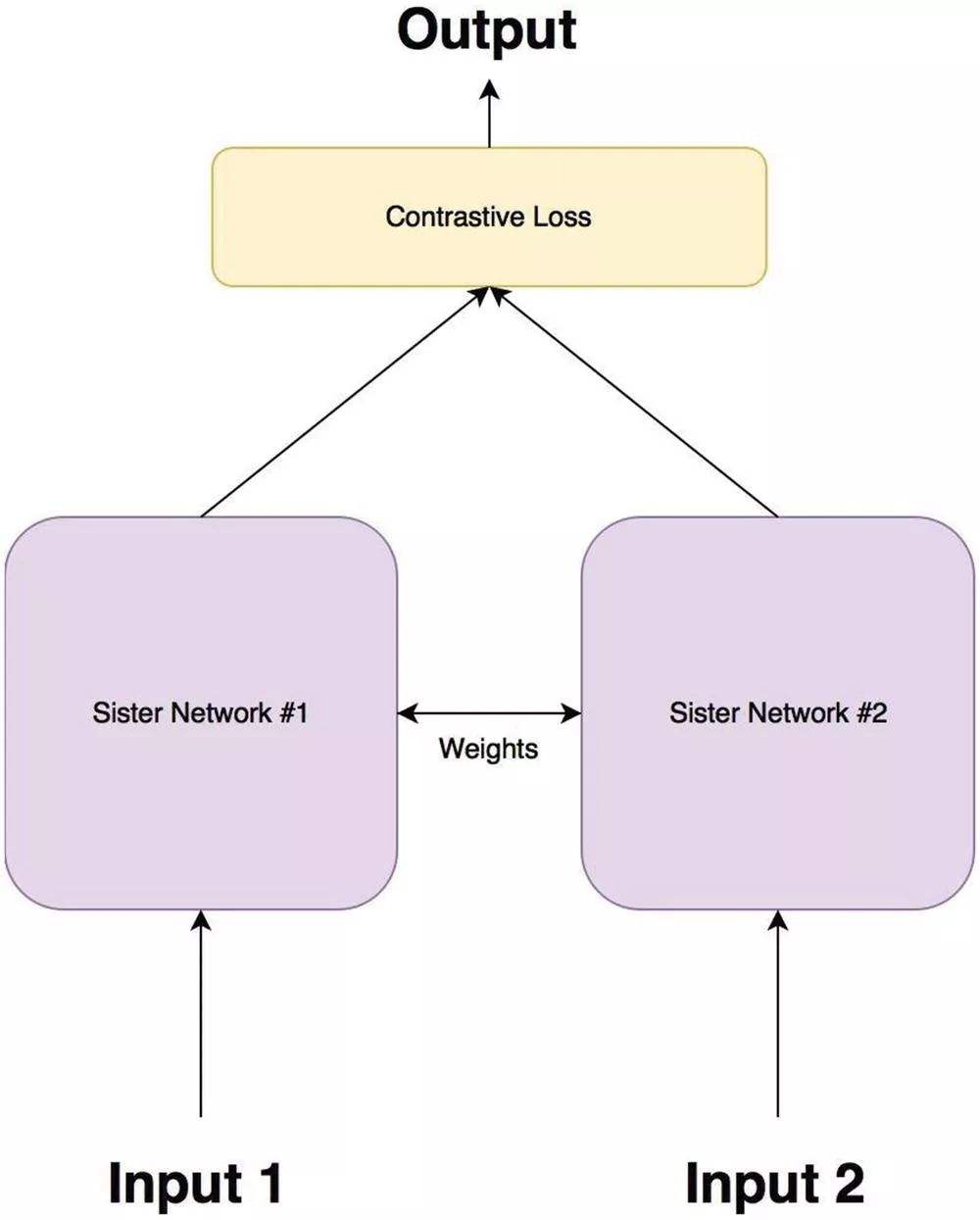
该损失函数可以有效的处理孪生神经网络中的paired data的关系,具体逻辑是:
- 若一对数据是同一组,那么
label = 1即y = 1,只有前半部分起作用,后半部分值为0;此时最小化loss, 两者的欧氏距离变小,就会使两者更相似; - 若一对数据非同一组,那么
label = 0即y = 0, 只有后半部分起作用,前半部分值为0,此时最小化损失函数,即最小化margin - d, 就等于最大化d,即两者的欧氏距离变大,更不相似
梯度求解
y = 1时,
此处省略,以后补充
代码实现
# ------------------------------------------------------------------------------
# # @Time    : 2020/5/17 上午 11:19
# # @Author  : fry
# @FileName: clac.py
# ------------------------------------------------------------------------------
'''
计算欧式距离
'''

import torch

def euclidean_dist_vector(x, y):
    '''

    :param x: [100]
    :param y: [100]
    :return:
    '''
    dist = torch.sqrt(torch.sum(torch.pow((x-y), 2)))
    return dist

def euclidean_dist(x, y):
    """
    Args:
      x: pytorch Variable, with shape [m, d]
      y: pytorch Variable, with shape [n, d]
    Returns:
      dist: pytorch Variable, with shape [m, n]
    """

    m, n = x.size(0), y.size(0)
    # xx经过pow()方法对每单个数据进行二次方操作后,在axis=1 方向(横向,就是第一列向最后一列的方向)加和,此时xx的shape为(m, 1),经过expand()方法,扩展n-1次,此时xx的shape为(m, n)
    xx = torch.pow(x, 2).sum(1, keepdim=True).expand(m, n)
    # yy会在最后进行转置的操作
    yy = torch.pow(y, 2).sum(1, keepdim=True).expand(n, m).t()
    dist = xx + yy
    # torch.addmm(beta=1, input, alpha=1, mat1, mat2, out=None),这行表示的意思是dist - 2 * x * yT
    dist.addmm_(1, -2, x, y.t())
    # clamp()函数可以限定dist内元素的最大最小范围,dist最后开方,得到样本之间的距离矩阵
    dist = dist.clamp(min=1e-12).sqrt()  # for numerical stability
    return dist
# ------------------------------------------------------------------------------
# # @Time    : 2020/5/11 下午 7:52
# # @Author  : fry
# @FileName: MatchLoss.py
# ------------------------------------------------------------------------------

import numpy as np
import torch
import torch.nn as nn
from utils.clac import euclidean_dist,euclidean_dist_vector
# match loss function

class ContrastiveLoss(nn.Module):
    """
    Contrastive loss function.

    Based on:
    """

    def __init__(self, margin=1.2):
        super(ContrastiveLoss, self).__init__()
        self.margin = margin


    def check_type_forward(self, in_types):
        assert len(in_types) == 3
        #[1,1,10,10] [1,1,10,10] [10]
        x0_type, x1_type, y_type = in_types
        assert x0_type.size() == x1_type.shape
        # assert x1_type.size()[1] == y_type.shape[0]
        # assert x1_type.size()[0] > 0
        assert x0_type.dim() == 4
        assert x1_type.dim() == 4
        # assert y_type.dim() == 1

    def forward(self, x0, x1, y):

        # self.check_type_forward((x0, x1, y))

        data_1 = x0 # [1,10,10]
        data_2 = x1 # [1,10,10]
        # euclidian distance
        distance = euclidean_dist_vector(data_1, data_2)
        # distance = euclidean_dist(data_1, data_2)
        md = self.margin - distance
        dist = torch.clamp(md, min=0.0)
        loss = y * torch.pow(distance, 2) + (1-y)*torch.pow(dist, 2)
        loss = torch.mean(loss/2)
        # loss = torch.sum(loss) / 2.0
        return loss
# if __name__ == '__main__':
#     citer = ContrastiveLoss()
#     a = torch.randn(10,10)
#     b = torch.randn(10,10)
#     y = torch.ones(1)
#     loss = citer(a,b,y)
#     print(loss)